

NZXT H500i review: A $100 case loaded with premium features - glasshissfin

At a Glance
Expert's Rating
Pros
- Supremely easy to material body in
- Superior cable management tools
- Packed with premium extras
- Smart Device fan/RGB restrainer makes management easy
Cons
- Limited front panel port survival of the fittest
- Top scatter filter is cheap and barely held in situ
- Awkward to add PSU cables Beaver State HDDs later on installation.
Our Verdict
The NZXT H500i blends clean design and outstanding cable direction with a boatload of premium features typically found in more dearly-won cases. It's extraordinary of the best cases under $100 that we've seen scorn a few minor flaws.
NZXT's highly regarded H700i and H400i cases shook up the status quo when they debuted in late 2017 by blending the crisp, unpretentious look of the company's popular S340 and S340 Elect with an integrated Smart Device that lights-out the company's Cam River software to manage your Personal computer's kindling and fans. Today information technology's the mainstream's turn. On Tuesday, NZXT has expanded the H-series with the launch of the $70 NZXT H500 and $100 NZXT H500i, two new cases that deliver the same cleanable design as their luxurious predecessors, just at a price more people put up afford.
With an integrated fan and lighting controller, two customizable RGB LED strips, a tempered glass panel, and cable management tools galore, the NZXT H500i offers a slew of premium features for a case that costs inferior than $100. And if you assume't need fantasy lights or NZXT's Smart Device, the H500 delivers the same strong core design As its sibling for $30 less.
Some cases will comprise available to preorder in the U.S. Tues, with an expected ship date in early June. NZXT transmitted us an H500i to test ahead of the declaration. Let's shape it out!
[ Further meter reading: How to pickaxe the perfective PC case ]
NZXT H500i: Overbold and clean outside
The NZXT H500i fits full ATX motherboards, merely it's still fairly concentrated for a mid-tower, measuring in at 210mm (8.26 inches) wide, 460mm (18.11 inches) tall, and 428mm (16.85 inches) elongate. (Installing an ATX motherboard required removal of the top fan first, in fact.) IT's also well-lined of thoughtful touches typically base in pricier cases.
Many cases slay sub-$100 price points aside swapping unstylish superior materials for plastic enclosures and acrylic side panels, for example. Not the H500i. NZXT composed the intact case from steel, exclude for a tempered-shabu side jury that shows off your Personal computer's internals. The design of that venire is indefinite of the topper we've seen, and superior to the H700i's.
 NZXT
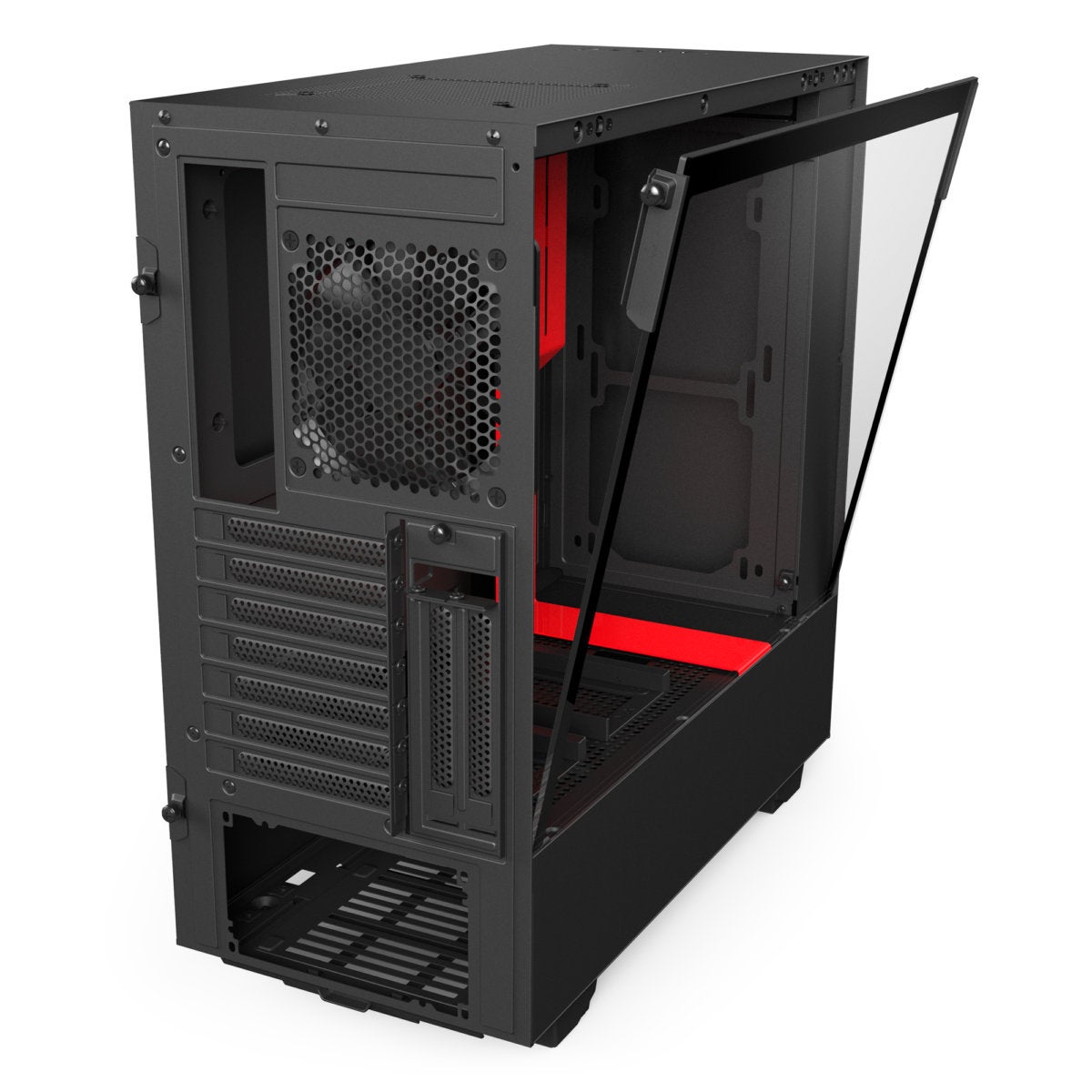
NZXT Removing the tempered meth go with panel is wonderfully simple.
Almost toughened-glass panels, even in high-end cases, indigence to be pressed against the case and fastened with screws in the four corners. Holding a large, terrifyingly fragile TG panel with one hand while trying to align it and screw it in with your other hand can shave age off your life (and leave the glass smeared with palmprints). The H500i's panel rests atop the overflowing-length power supply sheet instead, sitting flush with the steel elements of the case. Even finer, it's secured aside a small gold-bearing tab that wraps around to the back of the case and locks in via a single thumbscrew. Installing operating theater removing the panel is refreshingly fast and soft.
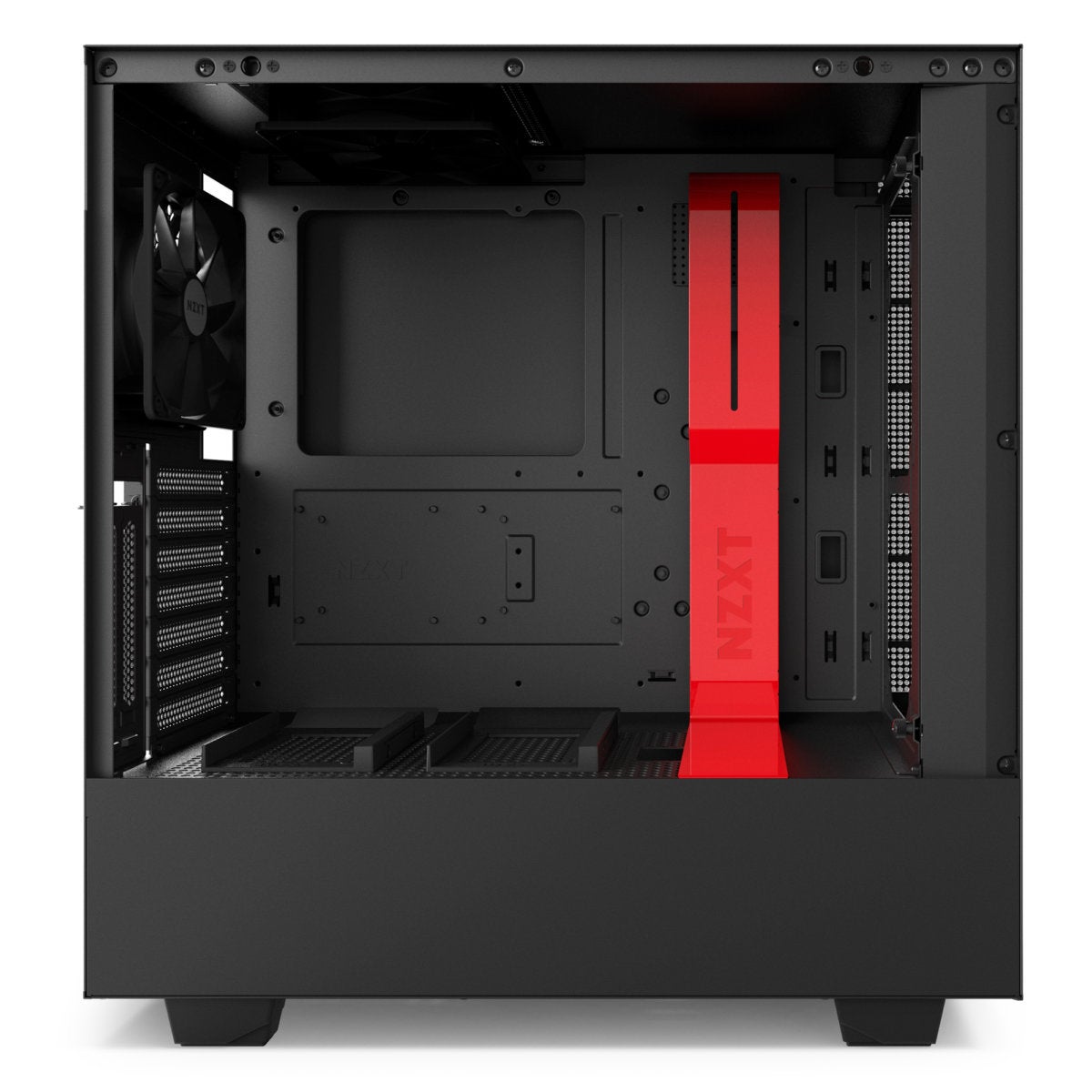
The clean design extends to the eternal rest of the exterior. As mentioned, the exponent supply cover stretches the full duration of the case, hiding your rocky drives as fountainhead. The top, front, and side panels feature clean-living, stark metal-looking, broken up only by the power button, a couple of USB 3.1 ports, and sound/mic knucklebones on the top lip of the case. NZXT's reviewers guide says the goal of the H-series is to "create a canvass fabric for builders to use to express their personal creativity," and IT shows (though an extra brace of USB ports would be wanted, overly). There isn't a single logo or any other ostentatious stigmatization on the outside of the case, though "NZXT" is subtly emblazoned happening an interior feature.
 NZXT
NZXT NZXT offers the H500i in matte white, matte black, matt-up black with red accents, and matte melanize with blue accents.
At that place isn't much external respiration, though the case didn't overheat our mental test build. A narrow ventilation strip is cut into the front edge of the steel side panel to provide airflow to front consumption fans. The $200 H700i included a twin line of ventilation crosswise the top edge of the impanel, but that top uncase is lost from the littler H500i. You'll also ascertain ventilation for up to a 140mm fan on the top and rise up of the case, and several cutouts to kick out air underneath the power supply.
NZXT H500i: Refreshful and clean in spite of appearanc, too
Good news, nitpicky builders: The NZXT H500i is reasonable as clean within as it is outside.
The eccentric ships with two of NZXT's Aer F120 fans preinstalled in the whirligig and rear mounts (compared to four fans with the $200 H700i). The front control board has room for capable two 140mm fans or a 280mm radiator, mounted along a removeable, slide-outer radiator bracket out that makes installation a breeze. That's a nice extend to seldom found in budget cases. An pick to install a 240mm radiator up top would've been nice to a fault, but the case is soh compact that doing so would've bumped into your RAM and other hardware.
 NZXT
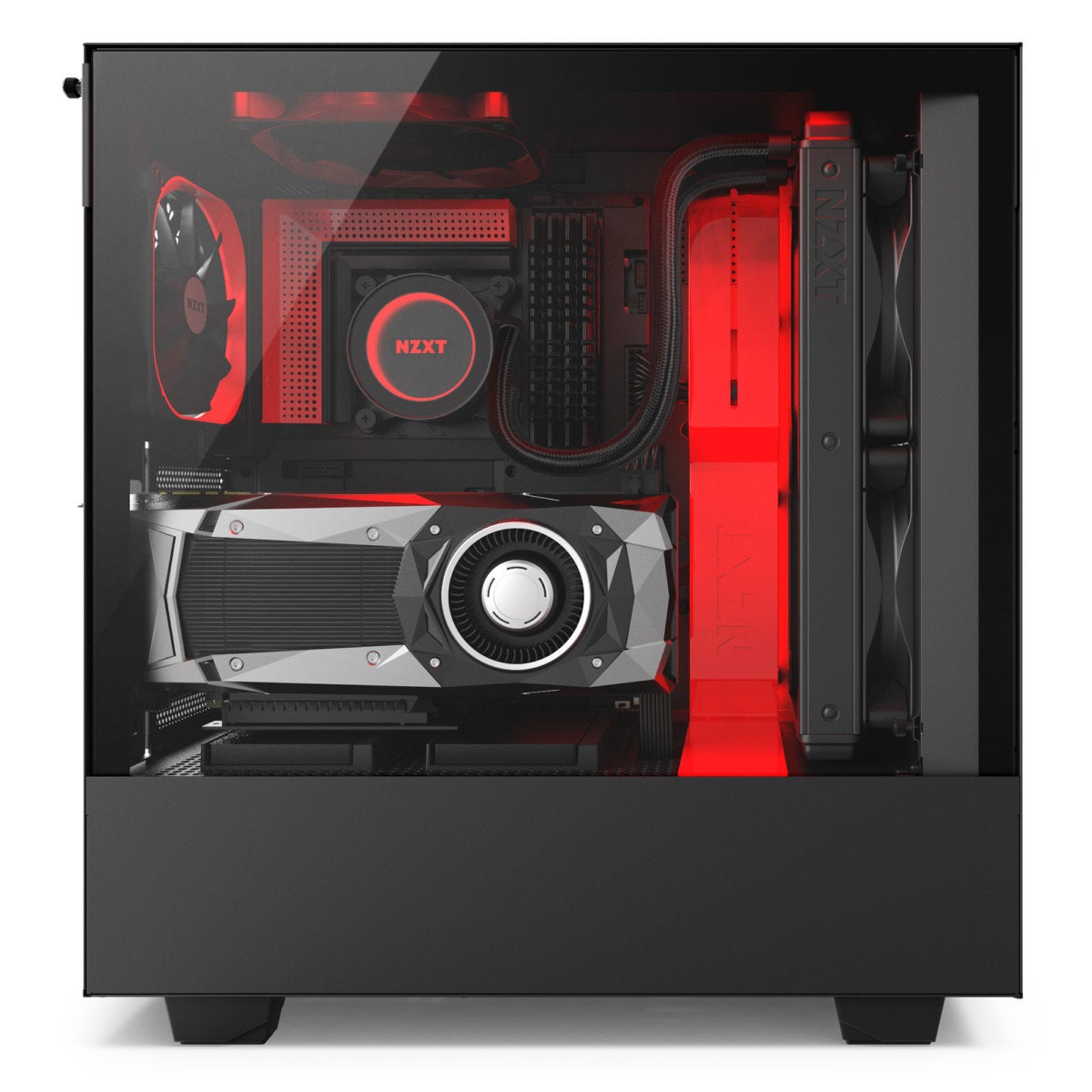
NZXT The vertical mounting bracket in the H500i lets you show off your graphics card if you have a separate riser card.
Other surprising duplicate for a mainstream eccentric: NZXT built a vertical GPU mount into the case if you want to show dispatch your graphics placard's shroud, too, though you'll need to wreak your possess riser card to the company if you need to actually use the hardware. (This is a $100 case later all.)
 Brad Chacos/IDG
 A look at the NZXT H500i's cable management block and removeable front radiator braket.
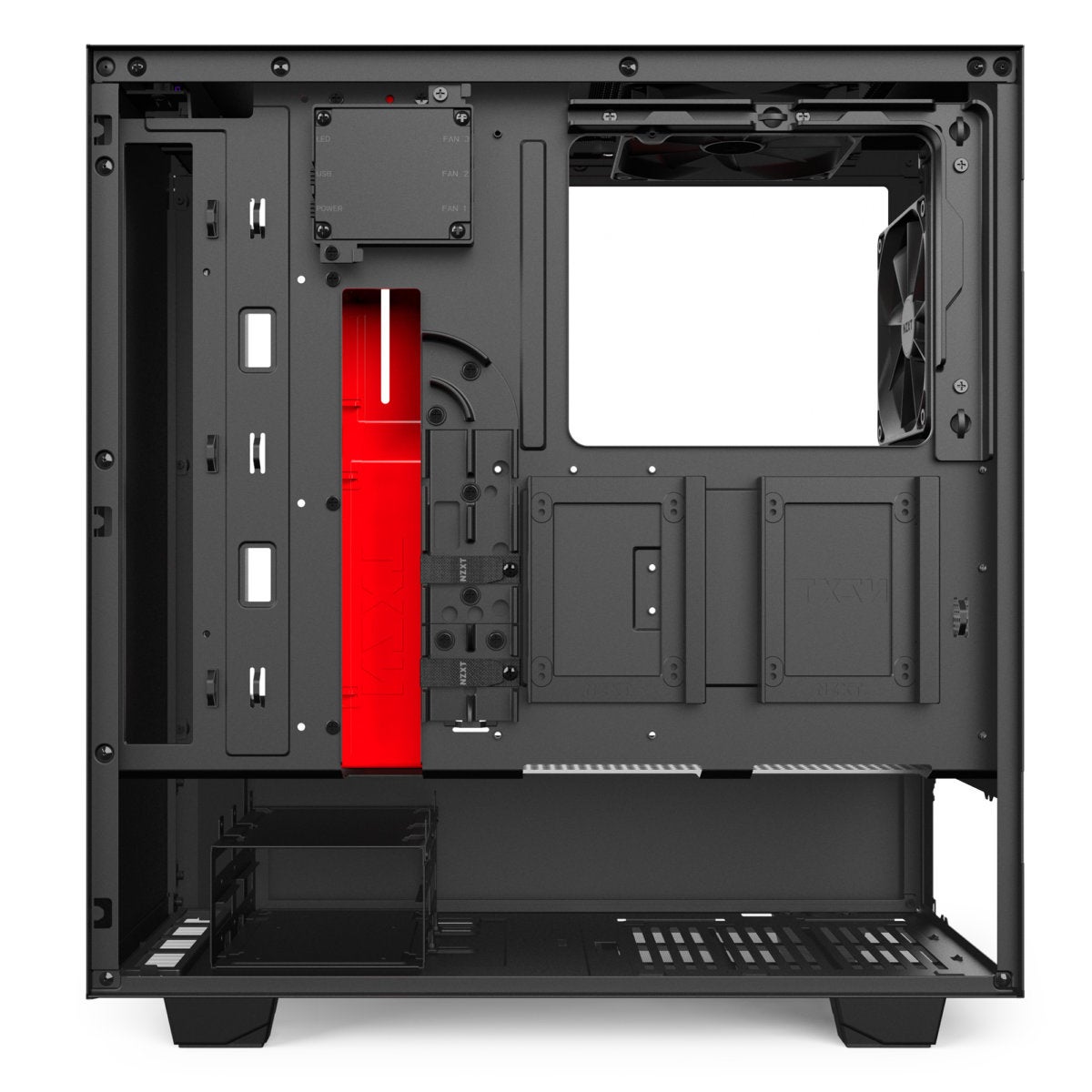
The H500i also includes NZXT's iconic cable management bar, a bare that covers the cable routing hole next to the motherboard to keep everything look nice and tidy. IT's a wonderful inclusion that can help oneself promote the looks of your trucking rig to the next level without much effort along your end. I hope to see something similar in to a greater extent cases active forward. The lack of rubber grommets on the motherboard cutout may irk several, but the edges aren't drill-like, and the cable direction bar's inclusion cleans up the event's look in any event.
Cable management is a priority end-to-end the H500i. The back end of the motherboard tray, behind the cutout concealed aside the cable management block u, includes a consecrate channel to tuck your wires into, complete with two Velcro strips to fasten those cables compact. You'll too incu a routing channel for fan and power cables above the motherboard cutout, fashioning it easy to run wires along the back border of the case. And speaking of clean, easy wiring, NZXT ships the H500i with its preinstalled fan and RGB ignition strips wired directly into the Smart Twist hub, eliminating the need for you to do soh. (Much on that by and by.)
 NZXT
NZXT The buttocks of the NZXT H500i's motherboard tray packs cable routing tools galore.
Excess cabling give the axe be tucked behind the full-length power supply shroud, too. That shroud earns one of our some gripes, too. While I value it's there, information technology can't be removed, and you pauperism to slide the power supply in via a cut-out below the backside motherboard tray. If you'Re using a standard power issue, be sure to wire it up before slippy it in, because between the permanent nature of the shroud and the hornlike push back squeeze near the PSU, it's deuced near impossible to work your fingers into the space to tot up more tycoo cables in the future.
[ Further reading: The best SSDs ]
The top of that cover is louvered across its total length. The NZXT H500's pair of SSD trays dress into them using a clever spring-loaded chemical mechanism that pops the trays free if you push in a bar unofficially. It's great. I love how the pattern lets you show off your SSDs evenhanded like the stay of your gear wheel, though I'd have preferred it if the SSD trays secured the drives using a toolless design similar to what you ascertain in the Corsair 570X. That case costs a pot more, though. If you don't like staring at your SSDs or the thought of your graphics lineup blowing immediately down on them, the trays can also be popped into the usual positioning behind the motherboard.
One affair you North Korean won't find in the NZXT H500i: An optical drive bay. But that's common in gaming cases these days, as galore (most?) manufacturers centerin instead on optimizing air flow from the front intake.
NZXT H500i vs H500: Get Intense (Device)
 Brad Chacos/IDG
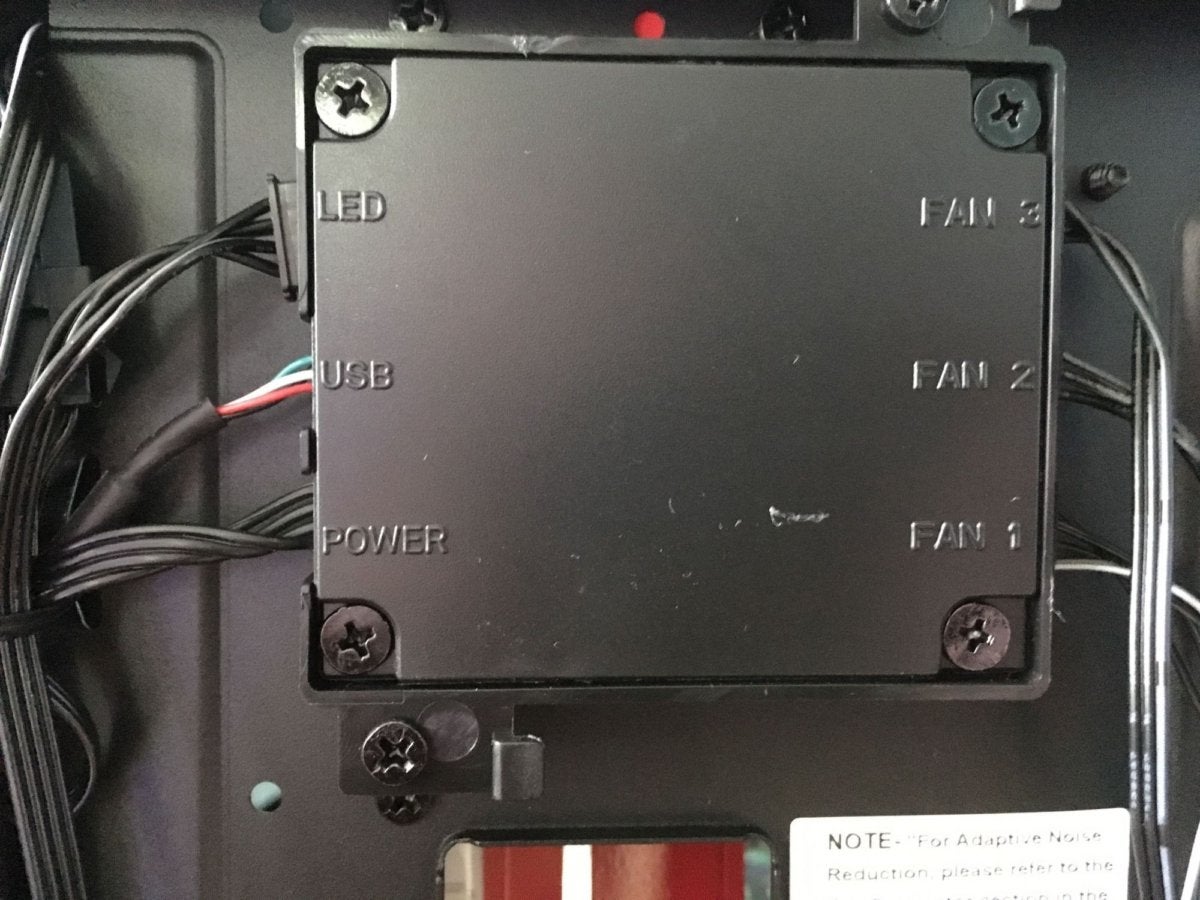
 The NZXT Smart Gimmick hides on the rear end of the motherboard tray.
Beyond the vertical GPU mount and the removable front radiator bracket, the difference between the $70 NZXT H500 and $100 NZXT H500i is the "I" that gives the latter its call. The H500i includes an integrated Smart Gimmick that gives the case intelligence operation by playing as sort of an all-in-one version of NZXT's Hue+ RGB lighting and Grid+ V3 fan controllers.
The NZXT H500 comes with two Aer F120 fans and deuce customizable RGB floodlighted strips (one behind the cable management bar, and another at the pinch of the type) preinstalled. All are wired into the Sharp Twist, which also includes a fan splitter that can support busy three additional fans, and a noise spotting module that measures the sound levels inside your case.
Downloading the NZXT Cam software gives you the ability to control the Smart Device (A well as some other goodies like component part monitoring, GPU overclocking, and an FPS overlay in games). The lighting tab key lets you tweak the colouring of the two RGB light strips, as well Eastern Samoa utilize visual effects suchlike breathing or pulse. Physical controls on the outside of the case are entirely wanting. But the truly interesting stuff is in the Adaptational Noise Reduction tab, which can only be accessed if you own an H-serial case with a Smart Device and register an NZXT account.
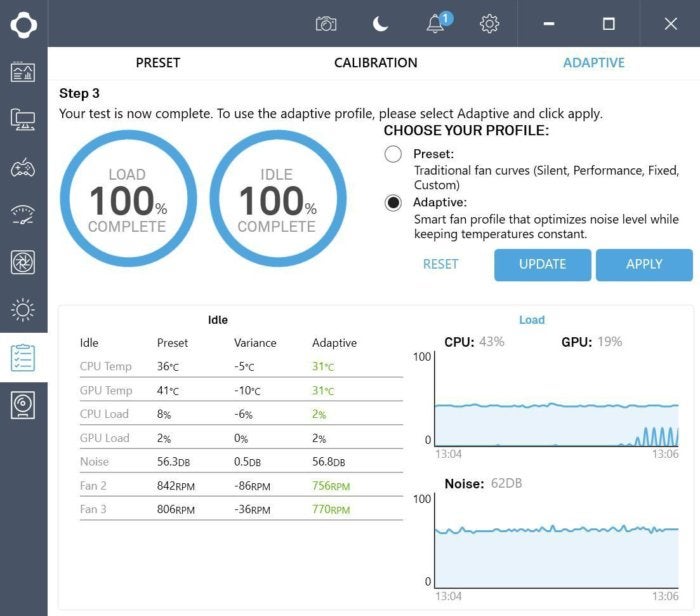
Reconciling Noise Step-dow debuted in the previous H-series cases (the like the H700i) but has been improved in newer software program releases. ANR uses the noise detection module inside the Smart Device to measure close noise as the software cycles your PC from idle to load. Earlier you can employ ANR, you need to calibrate the boast in a process that took 23 minutes on my try system. Adaptive Noise Reduction will and then use machine learning and its database of thousands of PC configurations in other H-series cases to create a custom winnow visibility for you.
 Brad Chacos/IDG
 Reconciling Randomness Reduction's earlier and later on metrics in our test build.
In a conversation with NZXT's Jim Carlton, helium emphasized that the lineament was designed with noise reduction in mind—hence the name. Achieving lower noise levels could result in slightly higher component temperatures if it requires the Stylish Device to reduce lover speeds. In the case of my quiz PC, the Adaptive Noise Reduction standardisation actually resulted in a 0.5 decibel noise growth, accordant to the Cam computer software, but groundless temperatures reduced aside 5 degrees Celsius on the C.P.U. and a full 10 degrees on the GPU, as you derriere see above. I'll take it!
I didn't see some reduction in temperature while flying the Deus Ex: Mankind Divided benchmark, and some enthusiasts might non want a server in the cloud mucking with their scheme thermals and noise levels. Others mightiness favor less heat in exchange for more sound. Fortunately, Adaptive Randomness Reduction is an optional lineament (albeit a flagship one for the H500i), and the optional Cam software too includes custom fan profile options and preconfigured profiles for more silence or more public presentation.
Should you buy the NZXT H500i?
 Brad Chacos/IDG
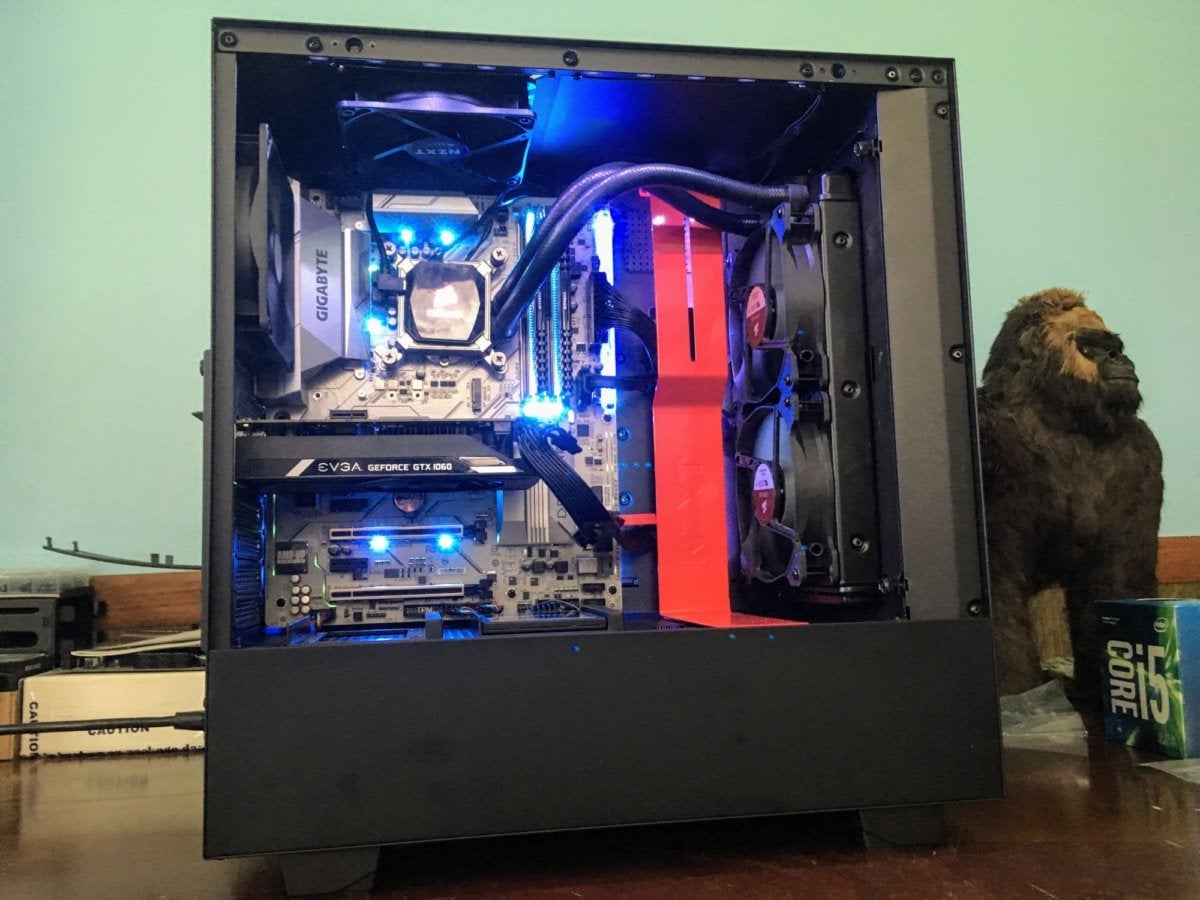
 The NZXT H500i packs premium features, premium materials, and bemused design typically found in much more expensive cases, only for only $100. The a couple of drawbacks I ascertained were more like little quibbles than actual flaws. Building in the H500i was an easy experience comparable building in rival cases with a big, empty interior, and it was made even simpler (and far cleaner) thanks to NZXT's plentiful cablegram routing options. The Smart Gimmick made my test system run much cooler at idle with barely some effort happening my end—a compelling feature for PC builders who aren't die-hard tweaking enthusiasts.
We haven't reviewed many cases here at PCWorld, simply the H500i stands foreland and shoulders above the other cases I've ever sick for $100 operating theatre to a lesser extent.
If you aren't interested in RGB lights, vertical GPU mounts, and NZXT's Smart Device, the NZXT H500 also seems like a great choice for $70. You buns enable RGB and sports fan check via else means if you privation, but still get NZXT's superb build quality and top-notch cable television direction options. NZXT's H-series continues to churn out excellent cases.
Source: https://www.pcworld.com/article/402017/nzxt-h500i-review.html
Posted by: glasshissfin.blogspot.com
0 Response to "NZXT H500i review: A $100 case loaded with premium features - glasshissfin"
Post a Comment